
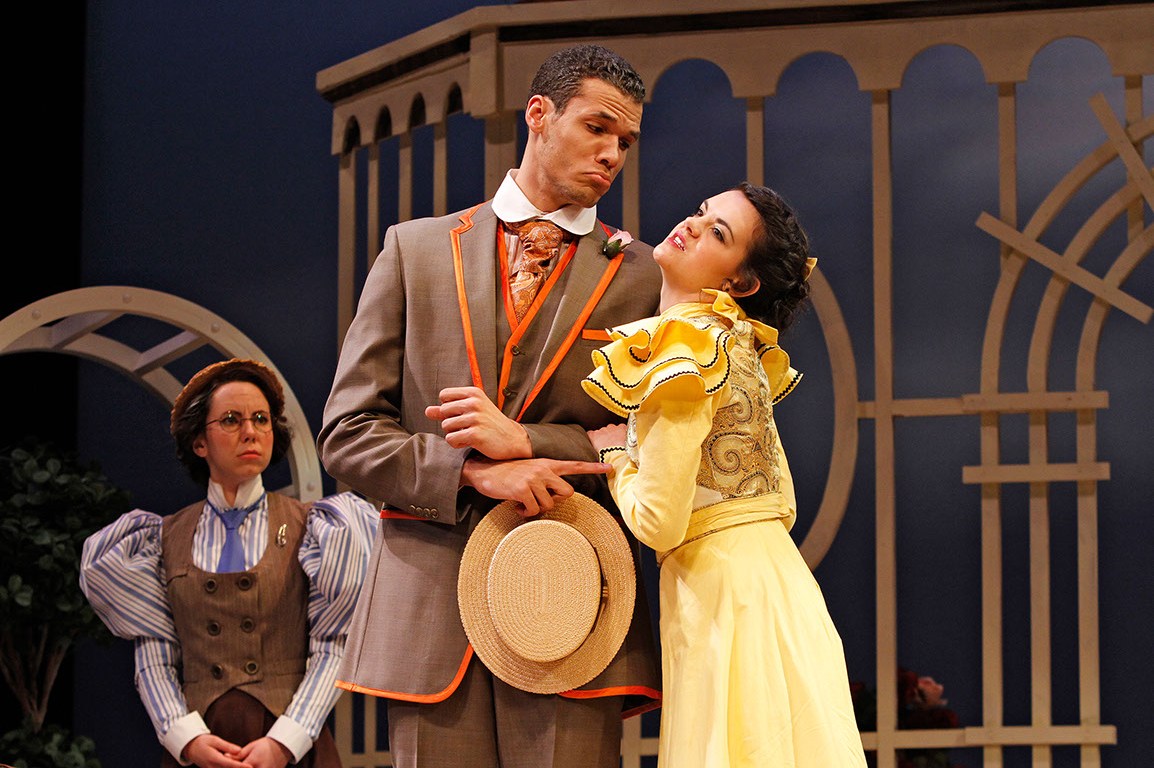
Oscar Wilde said it himself : “The first duty in life is to be as artificial as possible.” His play entitled The Importance of Being Earnest is plotted in the English Victorian society, whose hidden yet shrill hypocrisy is precisely made to create the most flavourful and entertaining story.
In the heart of a luxurious and privileged London, Jack and Algernon go from town to countryside, like every respectable social climber who is part of Victorian society. However, their lives and identities are very different when going from one place to another or when meeting various individuals. These irreplaceable characters, either Jack and Algernon or Gwendolen and Cecily, while not forgetting Miss Prism and Reverend Chasuble or the disdained Lady Bracknell, are often compared and contrasted, but they all give us a reason to reflect on identity and social belonging while offering the reader hilarious quiproquos and outlandish situations. Through the character of Gwendolen, for instance, Oscar Wilde satirises social conventions and correct behaviours within society. Lady Bracknell, on the other hand, represents the antithesis of her daughter Gwendolen, as her sole focus is on appearing suitable and respectable, explaining why she strongly disagrees with the union of Jack (claiming his name is Ernest at that very moment) and her daughter. But most importantly, these characters can explain the fact that this comedy made it through its time and continues to entertain us today.
The genius hiding behind this play is more complex than a simple satire of Victorian society. It is precisely an acknowledgement of social hypocrisy and morality. And while these two ideas might seem paradoxical, they are indeed linked to one another very subtly. The satirical and farcical elements building this play are followed by the acceptance of the idea that all human beings are confronted with a dilemma between their serious, sincere selves and their carefree, fictional selves. The moral neutrality of being artificial is the real theme, although hidden and quite implicit, of the play. Whereas Moliere, for instance, describes high society’s vanity and hypocrisy in a purely satirical way in his numerous plays, such as The Would-Be Noble and The Imaginary Invalid, Wilde’s way of amusing is not based solely on this manner and goal. It is built around the light acceptance that all human beings are likely to reach artificiality in their everyday lives, while being noble and rich – or not. And he eventually admitted it the preface of his only novel, The Picture of Dorian Gray, writing : “It is only shallow people who do not judge by appearances. The true mystery of the world is the visible, not the invisible.”
However, our spirits may feel the urge to ask : how is it that this play is made entirely out of paradoxes and still functions perfectly ? Because it is, as Wilde said quite accurately, a “trivial comedy for serious people,” which implies it works because of pun-making and irony. Indeed, Jack’s imaginary name, Ernest, has a double meaning. Apart from the first name, it also designates a very honest, loyal individual. Therefore, Wilde not only uses puns to ridicule Victorian society, but he also, through Algernon’s character, creates a dandy who, just like his companion Jack, invents himself a fictional invalid friend called Mr Bunbury to escape to the country and avoid social commitments.
Overall, the immense, almost excessive use of irony and wit in this play is crucial to the process of understanding its meaning and stakes, which involve a major tension between the artificial behaviour dictated by society and the natural, unbothered way in which Jack and Algernon wish to behave. It then becomes quite obvious that on the one hand, the fictional characters of Ernest and Mr Bunbury are symbols of double identity, duality and societal rebellion, while on the other hand, the large city and countryside represent urban sophistication versus simplicity and class critique.
So, why should every human being who respects himself read The Importance of Being Earnest ? For its many Ernests and the unique scenarios and quips that ensue, of course. But they should also read this play at any stage of their life to enjoy the delicious and guilt-free taste of admitting that we have all, at one time or another, been subjected to and perhaps even manipulated by our own, unique, and inevitable artificiality.
Valentina V.
Photo source : https://commons.wikimedia.org/wiki/File:The_Importance_of_Being_Earnest_%2816043211142%29.jpg
 ALETHEIA Vauban
